Skip to content
ECZ‑IDfor MSPs & MSSPs

The recurring service

Managed AI accountability, as a line on an agreement you already hold.

You operate it. Your client checks it without you.

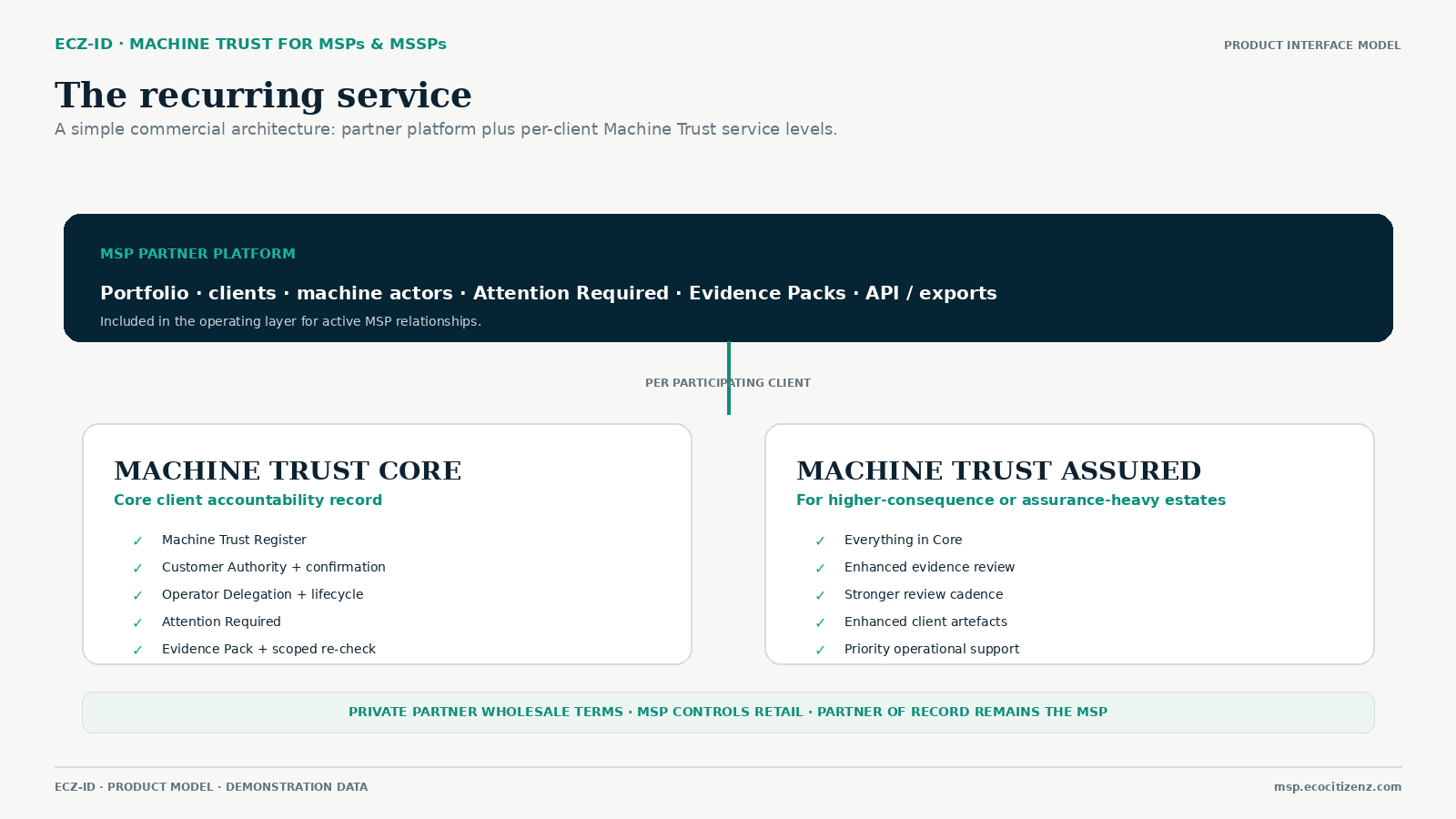
One service, sold per participating client: the machine actors associated with that client, the authority that client gave, the state that applies right now, and an Evidence Pack they can hand to whoever asks. It attaches to the managed services agreement you already have with them, and every customer-facing surface carries your firm as the operator.

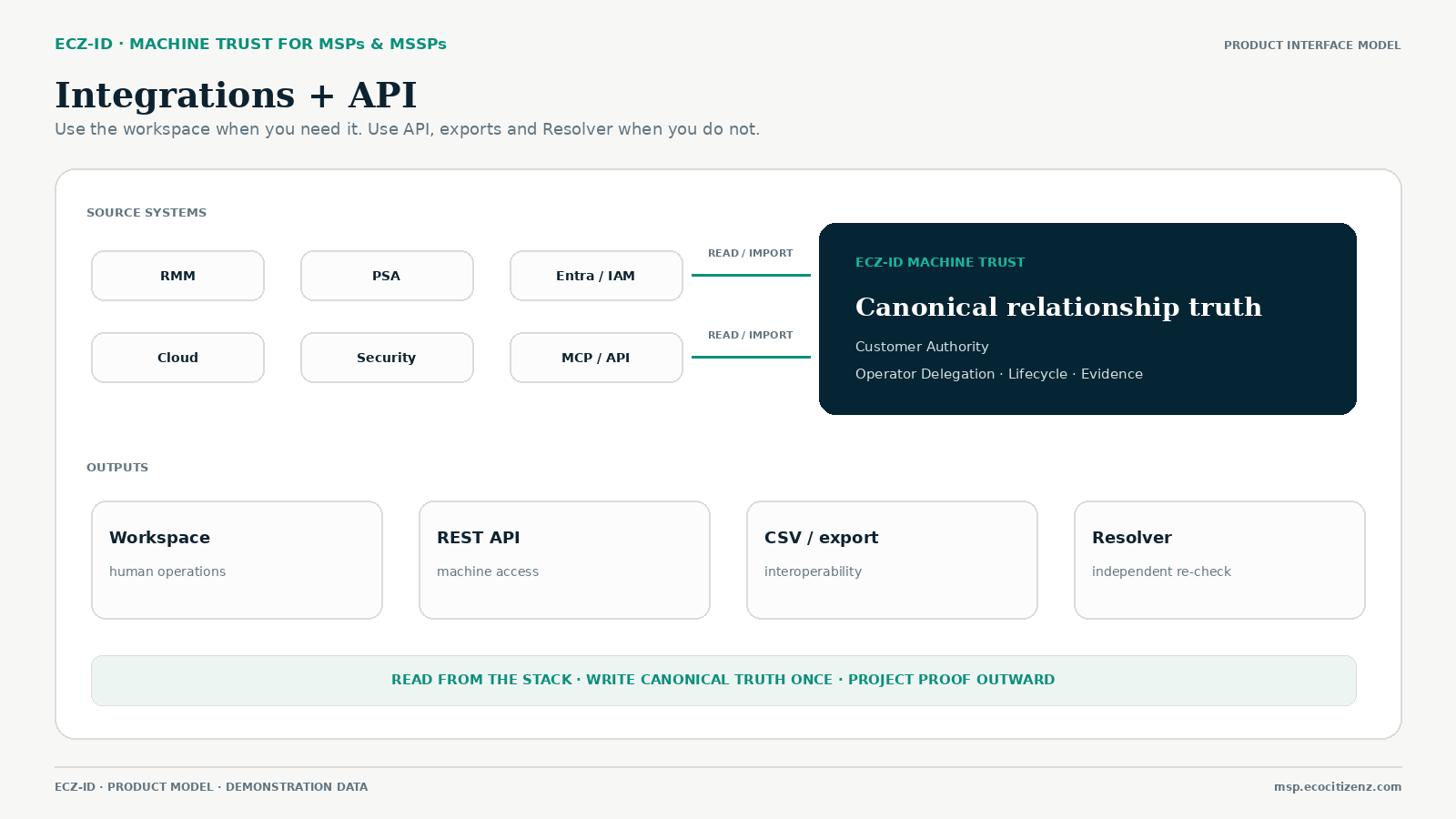
Designed to work alongside your RMM, PSA, IAM, OAuth and security controls — not replace them.

Where the revenue is

The work you already do, unbilled

The work this productises is work most MSPs already do — assembled by hand, after the fact, by the most expensive people in the business.

Quarterly review preparation

Assembling what changed in the client's estate, from several systems, by hand.

Security and insurance questionnaires

Answering control and third-party questions with evidence attached for each answer.

Supplier assurance requests

Responding when a client's own enterprise customers assess their supply chain — which routes to you.

Post-incident reconstruction

Establishing what acted, when, and under whose authority, after the fact.

Every one of those has a deadline attached to it and lands on whoever in your business is hardest to replace. Productised, the same work stops being a scramble: the record is already current when the question arrives, so the answer is a document you hand over rather than a week you absorb. The questions do not stop arriving.

Where those questions originate

Under Article 21(3) of the NIS 2 Directive (Directive (EU) 2022/2555), essential and important entities must, when considering which supply chain security measures are appropriate, take into account the vulnerabilities specific to each direct supplier and service provider, and the overall quality of products and cybersecurity practices of their suppliers and service providers.

Why it matters — When a client of yours is in scope, that consideration becomes a question they send to you. Answering it is evidence work, and today it is usually unbilled.

The duty falls on the in-scope entity and applies through national transposing law. Article 21(3) does not itself bring a supplier into scope — but note that Annex I lists managed service providers and managed security service providers as a sector of high criticality, so an MSP may be in scope in its own right under Articles 2 and 3.

ECZ-ID does not certify you as compliant with anything, and buying it does not make you compliant with anything.

Source: Directive (EU) 2022/2555, Article 21(3), Official Journal L 333/80, 27.12.2022 · verified 2026-08-13

The deliverable

What the client actually receives

A service with an artefact at the end of it, not an assurance that things are being handled. The list below is short because it is a list of things that can actually be handed over today.

Fig. 1In the client's hands
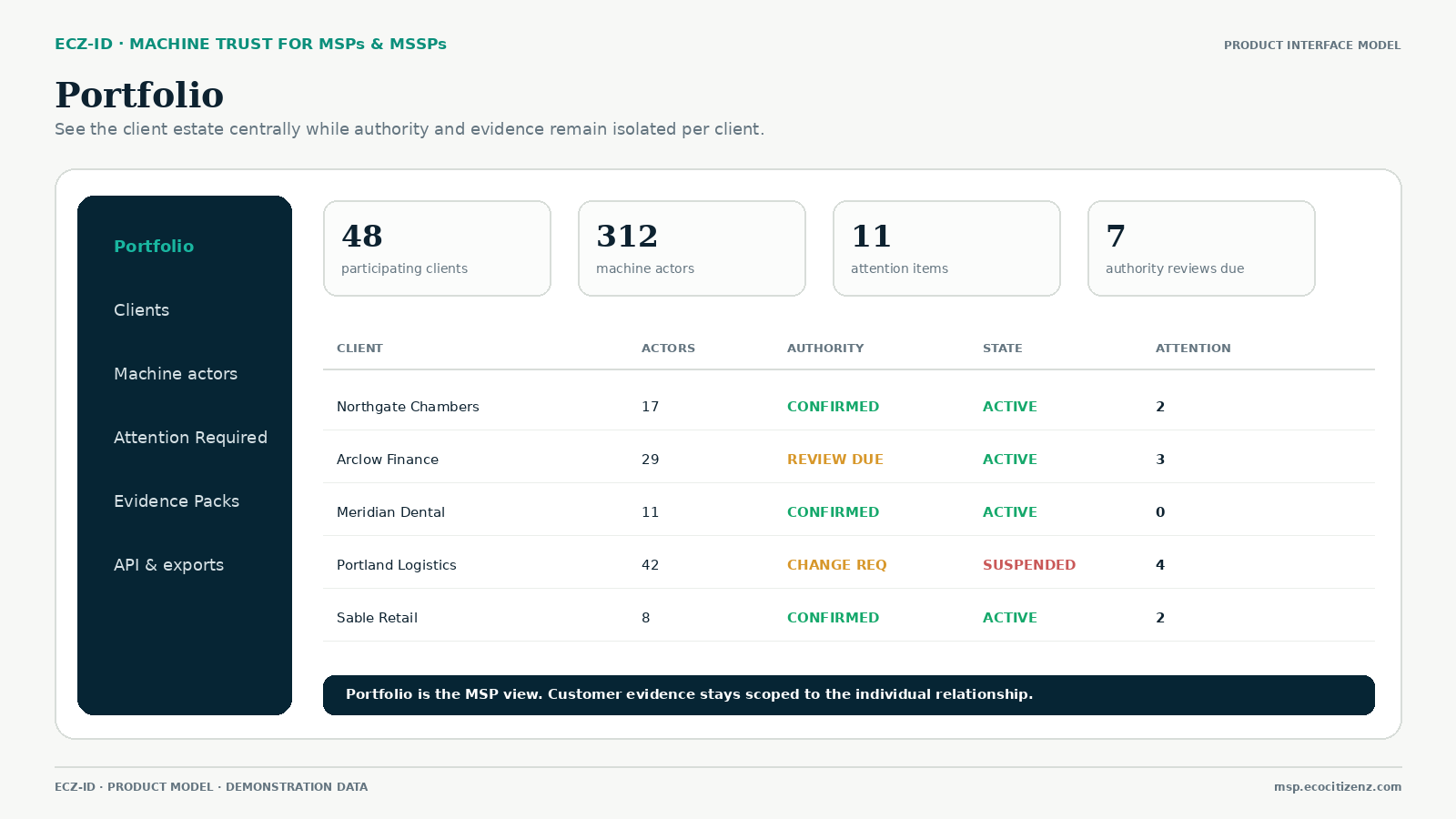
  • A Machine Trust Register listing the machine actors associated with each client, their native identifiers, and the surfaces they reach.Populated by an ECZ-ID operator during the audit, from tested import code. The self-service console is built but is not switched on in production yet.
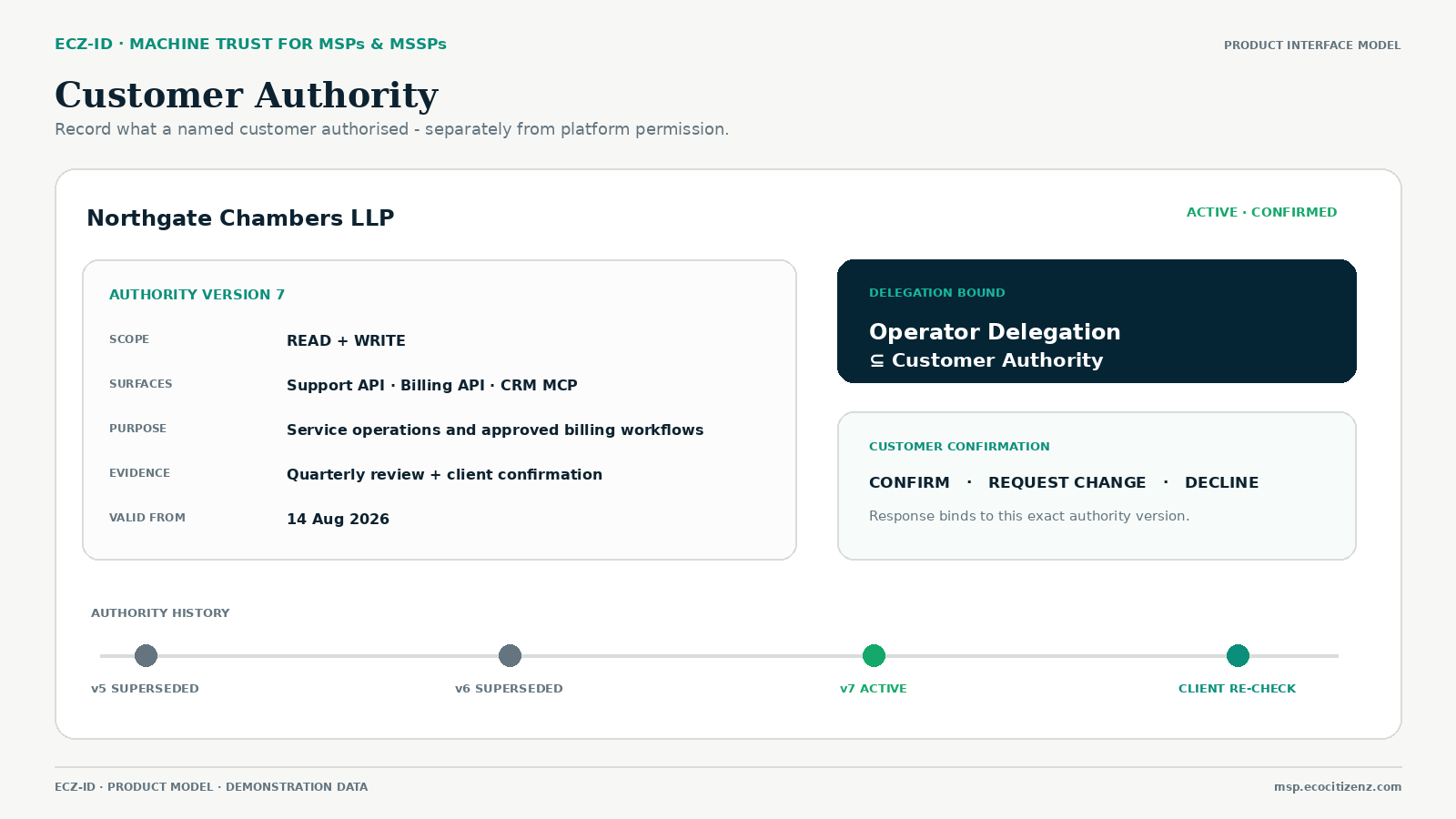
  • A customer authority record stating what the client has authorised, separate from what any system happens to permit.Recorded by an ECZ-ID operator during the audit, on the canonical authority model.
  • A confirmation request the client answers directly — confirm, request a change, or decline — without needing an account or a subscription.Issued by an ECZ-ID operator. The page your client answers is built and tested; it is not self-service for you yet.
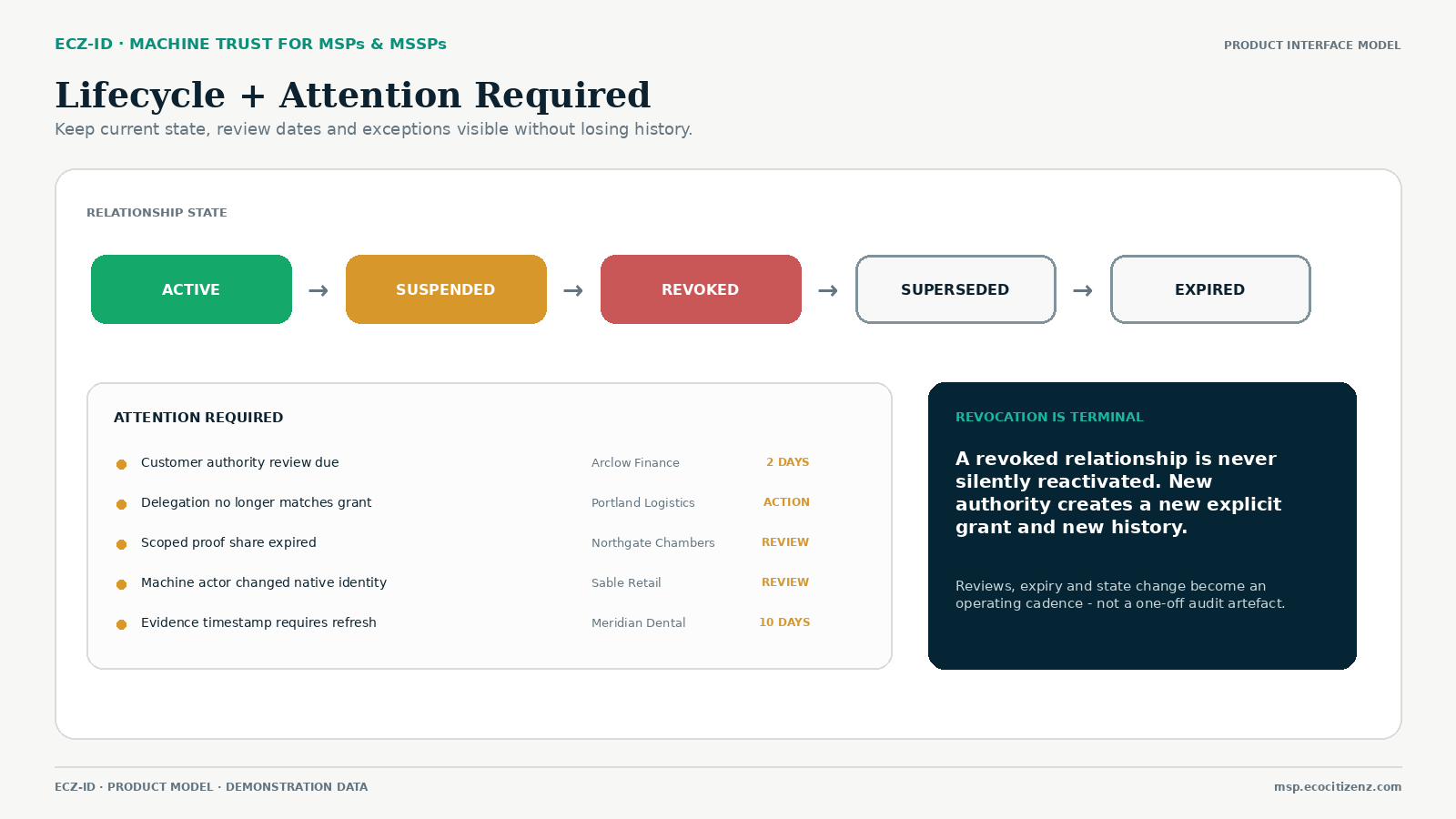
  • Current state for every grant — active, suspended, revoked, superseded or expired — with history retained and revocation treated as terminal.Maintained on the canonical model by an ECZ-ID operator. Self-service state changes are not switched on yet.
  • Attention Required: deterministic findings that surface what has changed or lapsed across the client base.Produced by the deterministic rule engine and delivered by an operator. The live queue view is built, not yet switched on.
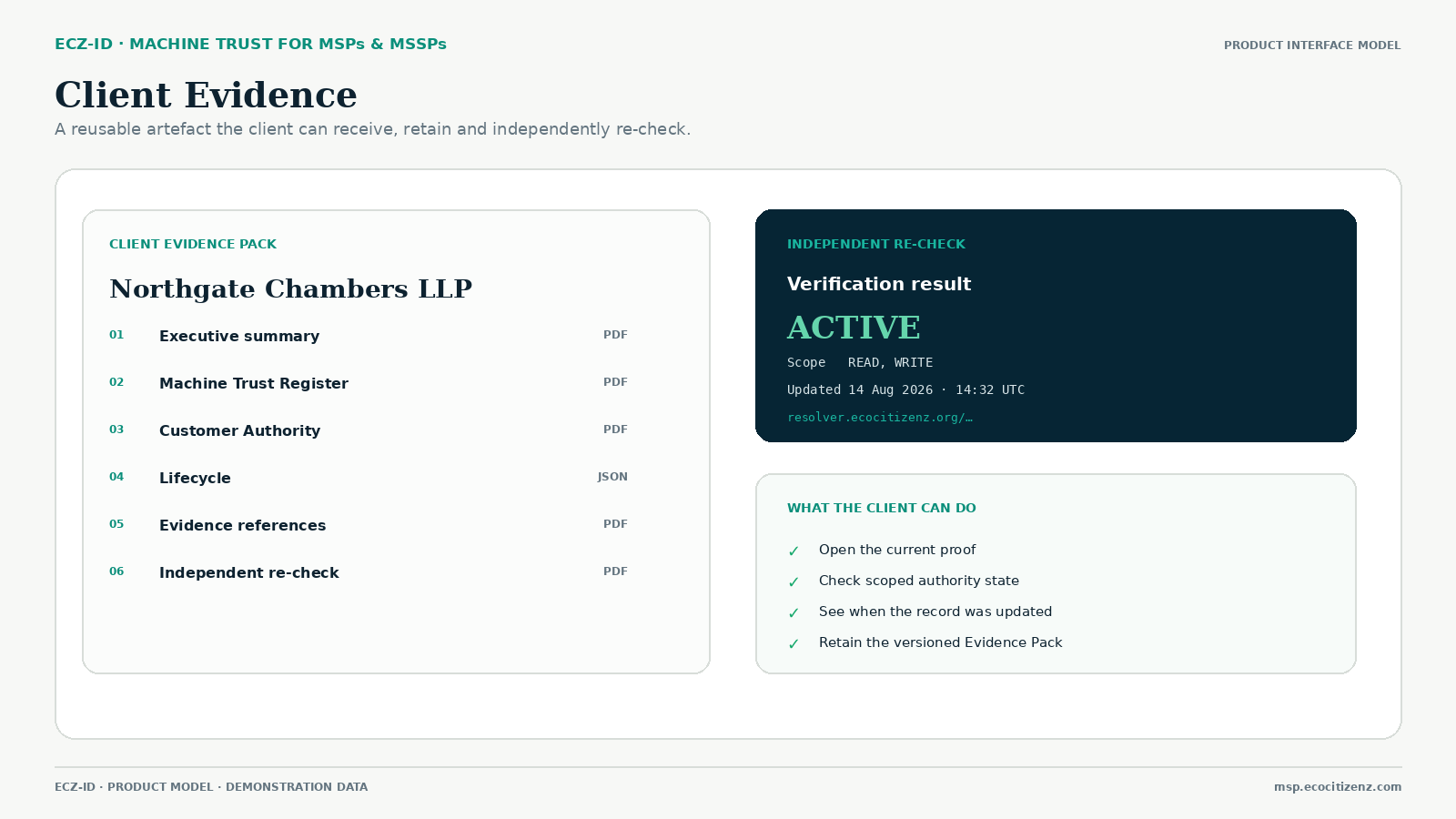
  • An Evidence Pack per client: a versioned document you can hand over at a review, a renewal or an audit.Generated from the canonical record and delivered by an operator.
  • Independent re-check: a proof view the client can open themselves, without going through you.Issued by an ECZ-ID operator. ECZ-ID’s own public resolver record is checkable today; customer relationship proofs are not switched on yet.
Every item here exists and can be delivered to your first client today. Nothing on this list is a roadmap item written in the present tense, which is why it is shorter than the list you could write for it.

Whose name is on it

The Evidence Pack is a versioned document per client, carrying your firm as the operator, that your client can hand to their own auditor, their insurer, or the enterprise customer assessing their supply chain.

The person they hand it to can open the proof view and re-check the current state themselves — without going through you, and without asking us for permission. That is what makes it worth handing over: your client is not asking anyone to take their word for it, and neither are you.

What it is not a record of

It records identity, authority, delegation, current state and evidence references. It does not record that a machine performed a particular action at a particular moment, and an entry in the Register is never proof that something happened.

What a machine actually did is a question for the system that executed it. Sell the record for what it is, because the first auditor who tests the stronger claim will find it does not hold, and it is your name on the document.

Attachment

How it attaches

The unit is one participating downstream business. The service is added to the agreement you already hold with that client, at the moment you already reopen it.

  1. 01

    On the agreement you already hold

    A line item on the managed services agreement that already exists between you and that client. Your client signs nothing with us and buys nothing from us. The commercial relationship stays exactly where it is.

  2. 02

    Per participating downstream business

    You choose which clients participate, one at a time. A client with no machine actor in their estate is not a candidate yet, and we would rather you left them out than opened a record with nothing real in it.

  3. 03

    At renewal, or the next review

    The natural moment is the one where the estate is already on the table and someone has already asked what changed. Introducing the service does not require you to manufacture a new commercial conversation.

Fig. 2One record per participating client
One MSP holds a separate authority record for each customerA single MSP node connects to four separate client nodes. Each connection is a distinct customer authority. The client nodes are not connected to one another: no client can see another client's record.Your MSPaccountable operatorAUTHORITYClient Aown record · own state · own proofAUTHORITYClient Bown record · own state · own proofAUTHORITYClient Cown record · own state · own proofAUTHORITYClient Down record · own state · own proofclientre-check
Each participating client is a separate unit of service with its own authority record, its own current state and its own proof. No client can see another client's record — the absence of a line between them is the isolation boundary, and it is enforced in the product rather than drawn here for effect.

Pricing, and what is deliberately not on this page

You buy at partner terms and set your own retail price. Terms are agreed in writing with each founding partner rather than published.

There is no recurring price anywhere on this site. We do not publish one, and we do not publish what you should charge for the service you build on top of it. Your cost base, your market and the service wrap you put around this are yours, and a number published here would manage to be wrong in both directions at once.

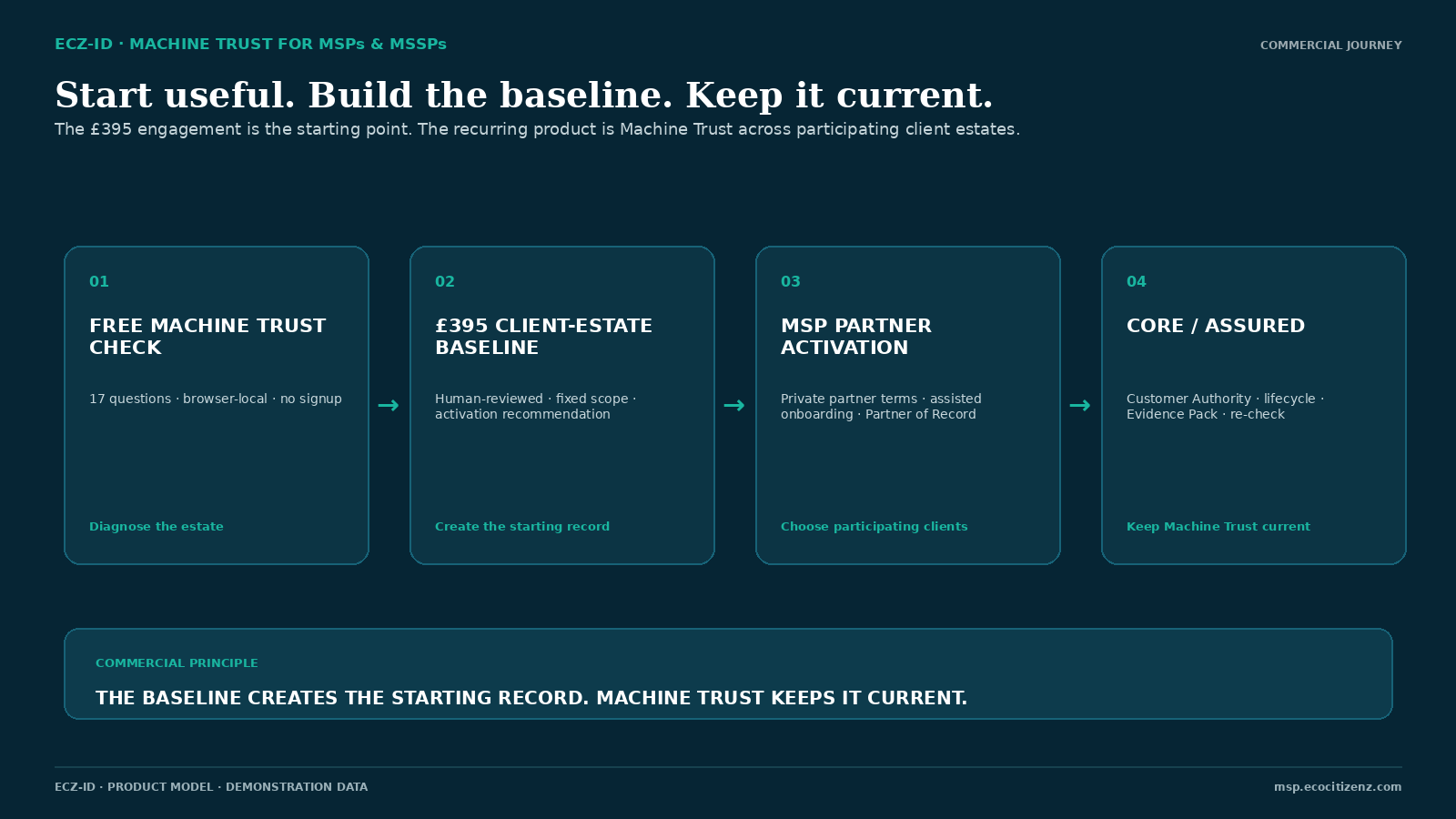
The one price we do publish is the £395 Client-Estate Machine Trust Audit, which accepted partners begin with. It is a fixed-price working step, not a subscription.

Partner of Record

Protections stated as structure, not as goodwill

Partner of Record is a field on every downstream record and it holds exactly one value. Everything in this section follows from that, which is why none of it depends on anyone at either firm remembering to behave well.

The commercial structure

  • You own the client relationship. ECZ-ID is never the retail brand.
  • You set the retail price. We do not publish what you should charge.
  • Partner of Record is structural — every downstream record carries exactly one.
  • Customer-facing surfaces read “operated by your firm, verified via ECZ-ID”. Never white-label: the independence is the product.
Deal registration
A customer you bring is attached to you at the point you bring them, before any commercial conversation involving them takes place. Registration is the act of writing the partner of record onto the customer record, so there is no separate register to fall out of step with the product.
No poach, and inbound routes to you
Every downstream customer record carries exactly one partner of record — yours. We do not solicit a partnered customer to drop their MSP, and inbound from your customers routes to you first.
Renewal ownership
The renewal conversation with your customer is yours to run. We do not run a renewal motion into a partnered customer base, and we do not appear in it uninvited.
A change of payer does not move the record
If who pays changes — a different billing arrangement, a group entity taking over payment, a customer moving between your own contracting entities — the partner of record does not move with the payment. The position follows the operating relationship, not the invoice.
Data portability
A customer who changes MSP re-parents to their new operator. Their authority records, their state history and their evidence references travel with them rather than being stranded in an account they no longer control.

Why portability, when lock-in would pay us better

Portability serves partners more than lock-in would, and it serves them in both directions. It is why you can win a client from another provider and inherit a working record instead of a blank page. It is also why a client you lose leaves with something intact, which is the version of that conversation you would rather have.

The record has to outlive the commercial relationship that created it, because a record that ends when a contract ends was never evidence of anything. We would rather be chosen at every renewal than retained by the cost of leaving.

Honesty

What we will not claim

We do not publish an ROI figure, a payback period or an attach rate for this service. We have no validated data for this category, and we are not going to model one and present it as evidence. If you are shown such a figure — by us or by anyone — ask what it was measured on, and how many customers were in the sample.

Return on investment, payback period, attach rate or margin for this service

No validated data exists for this category. Any figure would be invented, and inventing one is the fastest way to lose a technical reader.

Customer counts, partner counts, member counts or waitlist numbers

We are early and will not manufacture traction.

If you need a business case before you commit, build it from your own book: your rates, the hours the work above already costs you, and which of your clients would participate. We will help you structure it. We will not supply the figures, because the honest ones are yours and the invented ones are worth nothing to either of us.

Getting started

Day one, without connectors

Nothing about the first client, or the first invoice, waits on an integration. The Register is populated from what you already know and can already export. That is a design decision, not an interim state we are apologising for.

Structured intake

A guided form per client estate: the machine actors, who operates each one, what the client authorised, and which surfaces each actor reaches. Written answers only — no credentials are handled and nothing is installed anywhere.

CSV import

Export what your existing tooling already lists, import the file, and reconcile it against what you know. If an estate currently lives in a spreadsheet, that spreadsheet is the input.

Manual mapping

You attach a machine actor to a client, an operator and an authority by hand. It is the slowest route in, it depends on nobody but you, and it never stops being available.

Assisted mapping

Assisted onboarding for your first client estates, including mapping and import, rather than documentation and good luck.

Where connectors are heading

The direction of travel is read-only: reading what a system already holds so that a record can start from a system of record instead of from a form. An RMM such as N-able holds part of it. Microsoft Entra Agent ID holds another part. Reading from either would remove typing. It would not add capability, and it would not change what the record is.

None of this is available today.

No integration promised before it is production-ready. There is no date on this page, because we do not have one we would stand behind, and you should not build a service plan on a connector that does not exist. Everything you can sell today is in the four methods above.

What a connector would never do

  • Never write-back. A connector would read. It would never create, modify or delete anything in your systems or your clients' systems.
  • Never SIEM ingestion. We do not collect telemetry or event streams. A Register is not a log and will not become one.
  • Never gateway behaviour. Nothing routes through ECZ-ID. It does not sit in the path of a machine call, and there is no path through it to sit in.
  • Never execution. ECZ-ID does not act. It cannot block, throttle or intercept anything a machine does, and it is not being built towards that.

ECZ-ID records identity, authority, delegation, state and evidence, and projects a proof your customer can check independently.

Why read-only is the right direction

The Microsoft Entra Agent ID platform reached general availability. It provides the identity foundation for AI agents inside an organisation's own Microsoft Entra tenant: an agent identity is a service principal that, in Microsoft's words, “can only be issued tokens in the Microsoft Entra tenant where they're created” and “can't access resources or APIs in other tenants”.

Why it matters — Agent identity became a first-class object with a vendor behind it. Identity is not authority, and a tenant-scoped identity does not travel across the customers you manage.

Agent ID works with agents built on Microsoft and non-Microsoft platforms — the boundary is the tenant, not the vendor. Agent identity blueprints can be multitenant, but each tenant gets its own tenant-local identity and the identities themselves always remain single-tenant.

Source: Microsoft Learn — Microsoft Entra releases and announcements (April 2026 entry); Overview of agent identities in Microsoft Entra · verified 2026-08-13

Commercial access

Activation is by application

This service is activated through the ECZ-ID Founding Partner Programme. The qualification criteria are published in full, with the exclusions next to them and no scarcity mechanic attached to either. Read them, decide honestly whether they describe you, and apply if they do.

Accepted partners begin with a £395 Client-Estate Machine Trust Audit. It is the first working step of the relationship, not a report you buy and file.

What the audit produces