Skip to content
ECZ‑IDfor MSPs & MSSPs

ECZ-ID for MSPs & MSSPs

For MSSPs, MDR and SOC teams

A different object from an alert, and a different object from a log.

You already run detection and response. This is the record of authority behind the machine actors you and your customers operate — who authorised them, what state applies right now, and what your customer can check without going through you.

No signup. Your answers are evaluated in your browser and are never transmitted.

Designed to work alongside your RMM, PSA, IAM, OAuth and security controls — not replace them.

The artefact

What an operator-owned log cannot settle on its own

Your logs are not the problem. Telemetry is the operational truth of a security operation — what happened, on which host, in what order, under which identity — and detection, triage, containment and post-incident work all run on it. It is necessary, it is valuable, and nothing on this page replaces it or suggests otherwise.

What an operator-owned log cannot do on its own is hand an external relying party — your customer, their insurer, their auditor, their own enterprise buyer — something they can check without depending on your tooling and your good faith. To read it they need your platform, your retention window, your export and your reading of it. Everything they conclude, they conclude through you.

That is a structural property of who owns the record, not a criticism of the record. A log written by the operator, held by the operator and read through the operator is exactly what a log is supposed to be. It is simply not the artefact that answers “who authorised this machine to act for me, and can I confirm that myself?” — because that question is asked about you, and an artefact you control cannot settle it.

Fig. 1Three objects that are not grades of the same thing
ObjectWhat it recordsWho holds itHow an outside party reads it
AlertA condition your detection logic matched, at a moment in time.Your detection and response tooling.Through you — your console, your triage, your write-up.
Log / telemetryWhat happened, in sequence, with timestamps, across hosts, identities and network.Emitted by the system, collected and retained by you.Through you — your platform, your retention window, your export.
Authority recordWhat the customer authorised, who is answerable for it, what state applies now, and what evidence was referenced.You record it. The customer confirms it.Directly — a proof view the customer opens themselves.
The first two are how you know what happened. The third is how someone outside your firm knows what was permitted, by whom, and whether it still stands. A record that authority existed is not evidence that any action took place.

The reverse is equally true, and stating it is the price of stating the first part. An authority record will never tell you that a process spawned at 02:14, that a token was used from an unfamiliar network, or that a mailbox rule was created. It is not an account of what happened. Your telemetry is the only thing that is, and this sits beside it.

Alongside, not instead of

Where it sits next to your stack

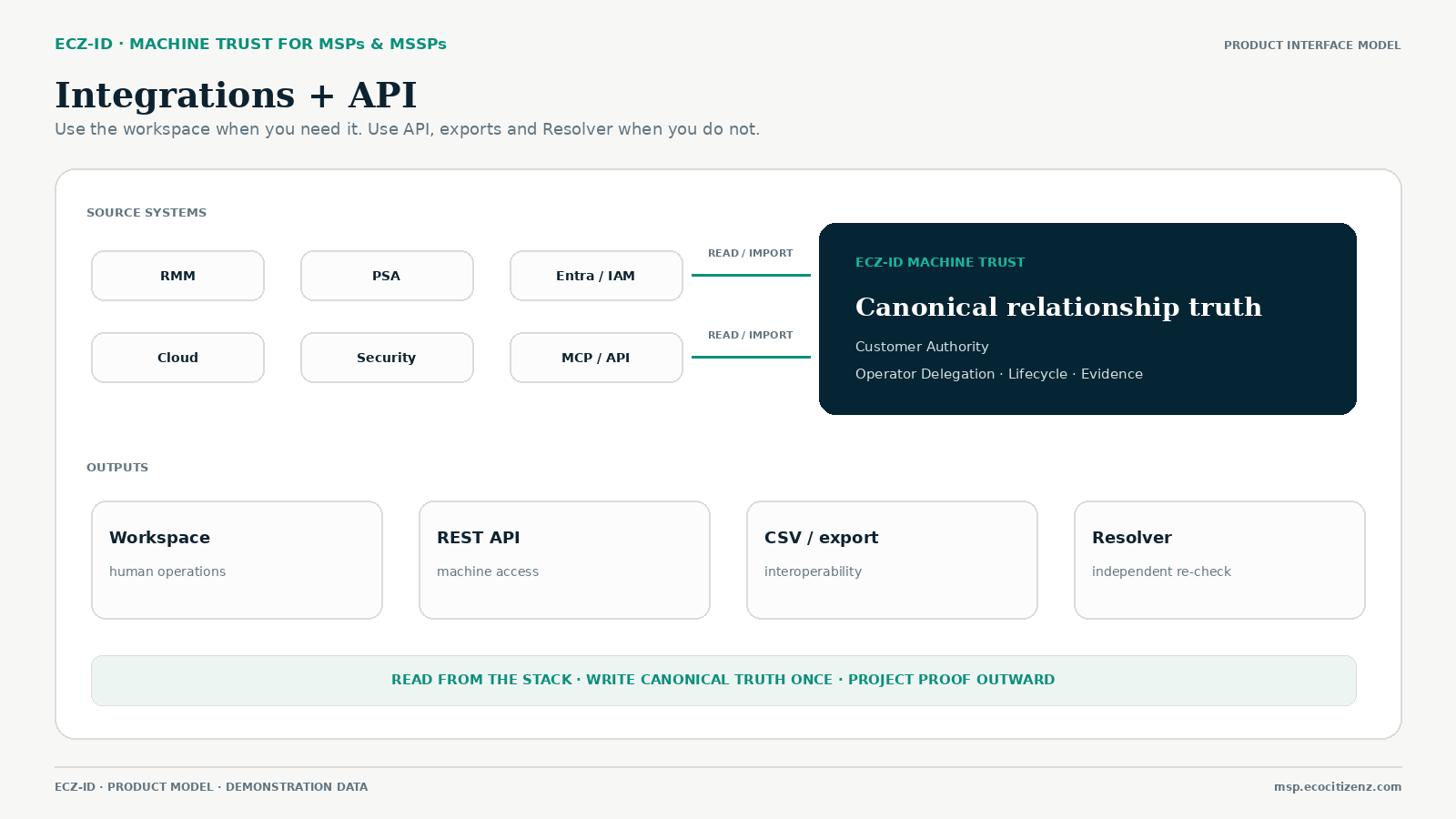
Every layer below does what it was built to do, and none of them was built to hold a per-customer record of who authorised a machine to act on that customer's behalf. The last row is the only thing ECZ-ID claims.

Fig. 2Your security stack, and the row this adds
LayerWhat it does
IAM / IdPEntra ID, Okta, OAuthAuthenticates identities and issues tokens.
SIEM / SOARSentinel, SplunkCollects telemetry and orchestrates response.
EDR / MDRDefender, SentinelOne, CrowdStrikeDetects and contains threats on the endpoint.
Gateways / orchestrationMCP gateways, workflow enginesRoutes and executes machine calls.
ECZ-IDMachine Trust Register, Customer Authority, proofECZ-ID records identity, authority, delegation, state and evidence, and projects a proof your customer can check independently.

What ECZ-ID is not

ECZ-ID does not replace your RMM, PSA, IAM, identity provider, OAuth, Entra, SIEM, SOAR, EDR, MDR, MCP gateway, workflow engine or orchestration platform.

  • ECZ-ID does not execute anything in your customers' systems.
  • ECZ-ID does not authenticate users or machines.
  • ECZ-ID does not monitor, detect or alert on threats.
  • ECZ-ID does not block, throttle or intercept a machine action.
  • ECZ-ID does not manage endpoints, tickets, contracts or billing.
  • ECZ-ID does not certify you as compliant with anything, and buying it does not make you compliant with anything.

This is the short list, stated plainly, because a governance product that is vague about its boundaries is indistinguishable from one that overreaches.

How the model works in detail

In an incident

Incident questions it answers, and the ones it does not

During the incident you are answering detection questions. Afterwards — in the review, on the insurer's form, in your client's board paper — the questions change shape. These four are the ones about authority, and they are asked about a specific point in time.

  1. 01

    What machine held authority for this customer at the time in question?

    Which agents, automations and integrations are associated with this client — named, with the identifier they carry in the system they run in.

    Answered by · Machine Trust Register

  2. 02

    Who authorised it, and when?

    What this client has actually authorised, recorded separately from what a system happens to permit. A platform permission is not a customer's authority.

    Answered by · Customer Authority

  3. 03

    Was it revoked, when — and can the customer show that to a third party?

    How fast the authority can be withdrawn, what state applies right now, and whether the withdrawal is something anyone else can confirm.

    Answered by · Lifecycle state

  4. 04

    What evidence was referenced, and by whom?

    What was referenced, when, and by whom — kept so that what was true at an earlier time is still answerable later.

    Answered by · Evidence references

What it does not answer

A technical reader will find these limits within an hour of using it, so they are stated here rather than discovered later.

The detection question
What executed, what was blocked, what the payload was and which host it touched are answered by your telemetry and your detection stack. This answers who was permitted to act for whom, on whose authority, and in what state. It is the authority question, and it is the only one being claimed.
What actually happened
A record that a machine held authority is not proof that the machine did anything. It is proof of what was authorised, by whom, when, and in what state. Anyone telling you an authority record reconstructs an incident is describing a product that does not exist.
The period before the record existed
State changes are recorded events with times and superseded records are retained, so the record answers what was true at an earlier time — from the first day it exists. It does not backfill. If the question is about a period before you began recording, this will not manufacture an answer.

The revocation drill

How fast can you turn it off, and who can independently verify you did?

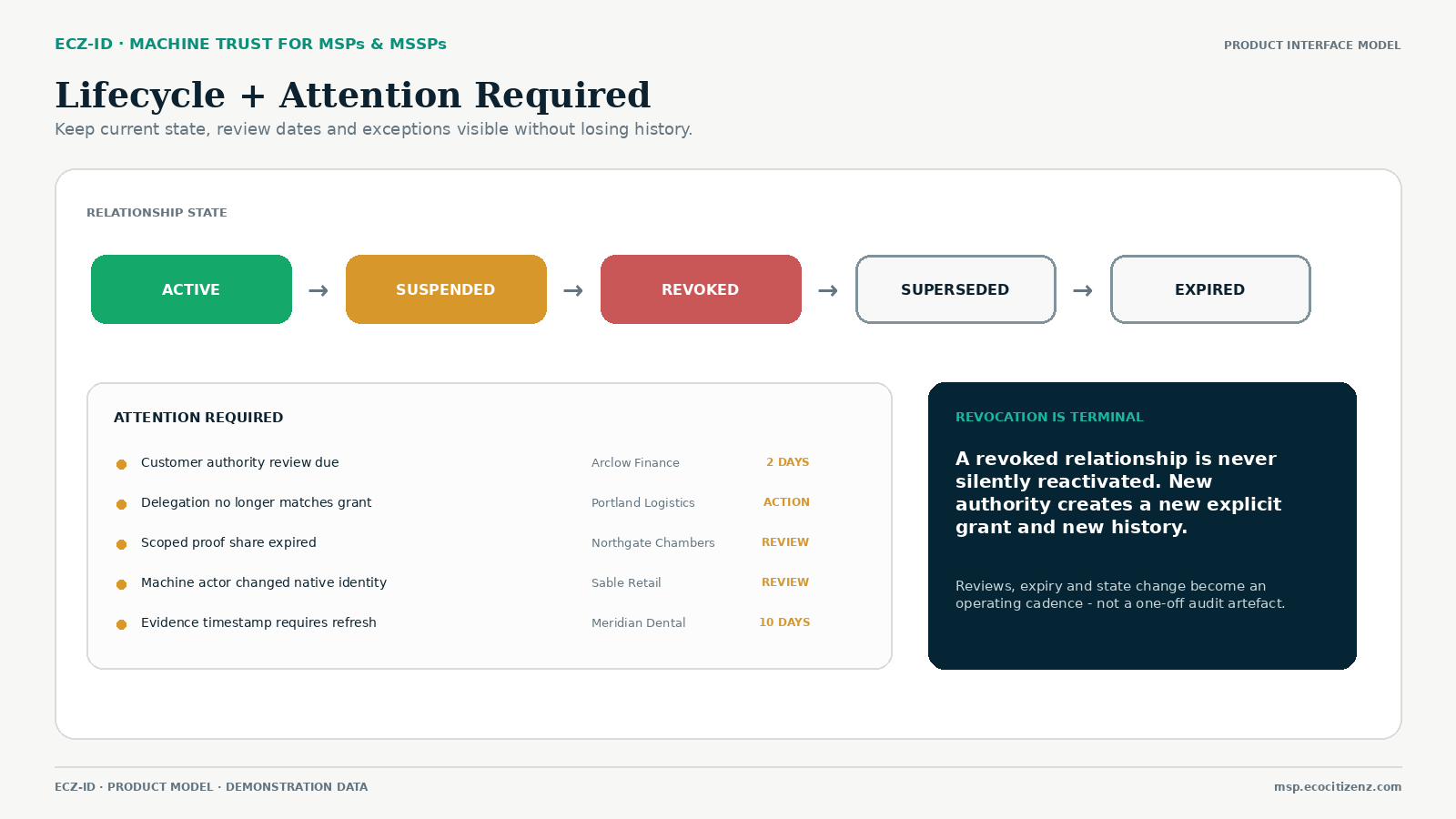
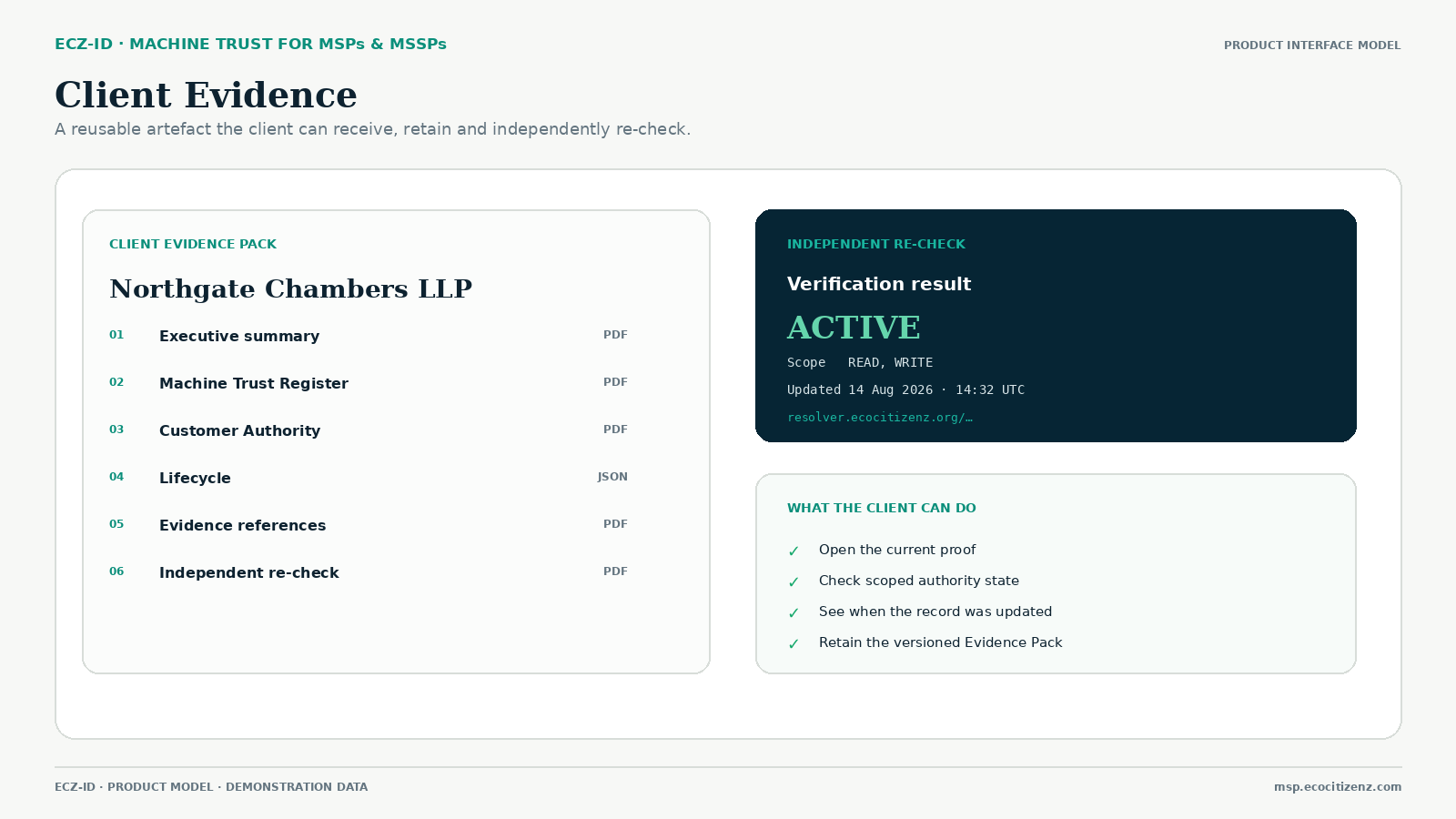
Suspension and revocation are recorded events with a time, not a silent change to a permission somewhere. A revoked grant is terminal — it is never resurrected, and a replacement is a new record with a new identifier. Your client can check the current state themselves without asking you and without taking your word for it.

  1. 01

    The question arrives

    In a supplier questionnaire, on an insurer's proposal form, or at two in the morning from a client who has just read something. The wording varies; the question does not.

  2. 02

    You suspend or revoke

    Suspension pauses authority and is reversible — reinstatement is itself a recorded event, not a silent restore. Revocation withdraws authority and is terminal.

  3. 03

    The change is recorded as an event, with a time

    Not an untimed edit to a permission somewhere that has to be reconstructed afterwards from memory and screenshots.

  4. 04

    Current state changes on that customer's record

    The record carries one current state — active, suspended, revoked, superseded or expired — and the history behind it stays.

  5. 05

    The customer re-checks independently

    They open the proof themselves, without asking you and without taking your word for it. You are not in the loop, which is the whole reason their answer carries weight with the person who asked them.

  6. 06

    Revocation stays revoked

    A revoked grant is never resurrected. A replacement is a new record with a new identifier, so the earlier position remains answerable rather than being overwritten.

What the drill is not

Withdrawing authority in ECZ-ID does not disable a token, terminate a session, remove a role or stop a running process. Those are actions in your identity provider, your gateway and your endpoint tooling, and you carry them out there. What ECZ-ID does is record that authority was withdrawn, when and by whom, and put that in front of the customer to check for themselves. Treating the record as the kill switch would be a mistake, and we would rather say so here than have you find out during the drill.

Fig. 3Lifecycle states and what each one means
StateMeaningReversibleRule
ACTIVEAuthority stands and the machine actor may act within it.YesCan be suspended or revoked at any time.
SUSPENDEDAuthority is paused. Nothing is deleted and the history stays.YesReinstatement is a recorded event, not a silent restore.
REVOKEDAuthority is withdrawn.NoTerminal. A revoked grant is never resurrected — a new grant is a new record with a new identifier.
SUPERSEDEDA newer grant replaced this one.NoThe superseded record is retained so that what was true at an earlier time is still answerable.
EXPIREDThe grant reached the end of its term.NoExpiry is recorded as an event with its time, not inferred from a missing row.
Revocation is terminal by design. Suspension is the reversible state and reinstatement is recorded as its own event, so the answer to “was it ever turned off, and for how long?” survives the incident that prompted it.

Regulated customers

When your customer is the one in scope

Often you are not the regulated party — your customer is. The way their obligation reaches you is a question, in writing, with a deadline, addressed to the provider holding privileged access to their estate.

In force · verified 2026-08-13

Under Article 21(3) of the NIS 2 Directive (Directive (EU) 2022/2555), essential and important entities must, when considering which supply chain security measures are appropriate, take into account the vulnerabilities specific to each direct supplier and service provider, and the overall quality of products and cybersecurity practices of their suppliers and service providers.

The duty falls on the in-scope entity and applies through national transposing law. Article 21(3) does not itself bring a supplier into scope — but note that Annex I lists managed service providers and managed security service providers as a sector of high criticality, so an MSP may be in scope in its own right under Articles 2 and 3.

Our reading, not the Directive's words. When a client of yours is in scope, that consideration becomes a question they send to you. Answering it is evidence work, and today it is usually unbilled.

Source: Directive (EU) 2022/2555, Article 21(3), Official Journal L 333/80, 27.12.2022

Answering that question well is evidence work: the machine actors named, the authority behind each one, the state that applies now, and something the person asking can check for themselves rather than file on trust. That is the artefact this produces, and it is the same artefact whether the request came from a regulator's transposing law, an insurer, or a client's largest customer.

Nothing in Article 21(3) names a product, nothing on this site is a legal opinion, and buying ECZ-ID does not make you compliant with anything. What it gives you is a record you can hand over and they can verify.

Next

Start with the check, not with a conversation.

The Machine Trust Check asks about the machine actors operating across your client estates and returns findings, not a score. If there is nothing to record yet it will say so, and that is a real answer rather than a reason to book a call.

What accepted partners begin with

Accepted partners begin with a £395 Client-Estate Machine Trust Audit. It is the first working step of the relationship, not a report you buy and file.

You buy at partner terms and set your own retail price. Terms are agreed in writing with each founding partner rather than published.

How access works

There is no countdown, no seat count and no waitlist number. The criteria are published above; if you meet them, apply.

Read the qualification criteria first